Personal
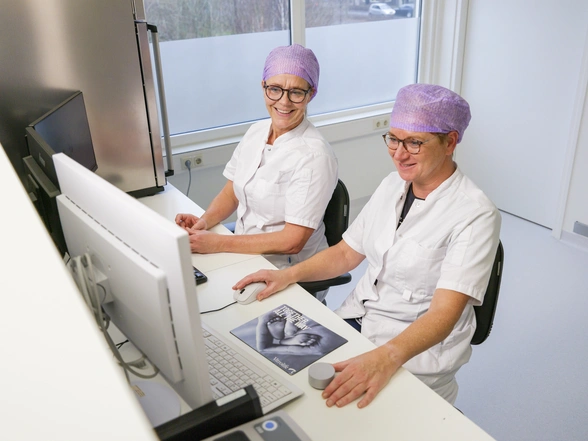
With personal support, we make sure everyone feels heard and at ease.

Donor eggs can be a solution for heterosexual couples where the woman has no usable eggs of her own due to early menopause, genetic conditions, medical treatments or repeated unsuccessful IVF attempts.
Single women can use donor eggs if they have no usable eggs of their own, for example due to a medical condition, early menopause or fertility problems.
Female couples can use donor eggs if neither partner has usable eggs, for example due to a medical condition, a genetic abnormality or fertility problems. They can also choose the ROPA method, in which one partner donates an egg and the other carries the pregnancy.
Male couples can use donor eggs in combination with a surrogate to fulfil their wish to have a child. One of the partners can be the biological father.
At Nij Clinics | Elsendorp, we have our own donor bank with eggs. Treatment with donor eggs is only possible if the person receiving the embryo transfer is younger than 40. The eggs stored in our donor bank are intended exclusively for treatments at our own clinic. Donor material from our bank is therefore not supplied abroad.
We ensure a strict selection of the donors we work with. Donors are selected on the basis of serological tests and motivation screening, and we place emphasis on the ethical aspects of donation.
Becoming an egg donor?
→ We are always looking for egg donors. Would you like to become an egg donor or find out more? Read more here.
At Nij Clinics, we work with carefully selected donors who have undergone extensive medical and genetic screening. What really sets us apart is our personal approach: we offer tailored support and guidance throughout the entire process – from donor selection to treatment. Caring for your wish to have a child.
Ovumia is a Finnish donor bank that specialises in fertilising donor eggs and supplying embryos to fertility clinics. Together, Nij Clinics and Ovumia focus on a personal approach to guide intended parents in finding the right egg donor.
Ovumia has a careful and transparent donor policy. All donors undergo extensive medical and genetic screening to ensure their health and suitability. Donor selection is strict and complies with both Finnish and Dutch legislation.
Ovumia only offers open-identity donation. This means that children born from donor eggs can gain access to identifying information about the donor later in life, in line with Dutch regulations.
Under the Finnish Fertility Act, recipients may only receive basic information about the donor: ethnicity, height, hair colour, eye colour and skin colour. Ovumia matches donors with recipients on the basis of these five characteristics, with the aim of finding a donor who resembles the female partner as closely as possible. Donors must give explicit consent for treatment in the Netherlands and for sharing the required registration details.
Within Nij Clinics, this treatment is only offered at our Elsendorp location. Treatment with donor eggs from Ovumia is possible if the person receiving the embryo transfer is younger than 47.
If you would like to use donor eggs, you can register with Nij Clinics. We will carefully discuss the process with you and guide you through it. Both the intake and the treatment (embryo transfer) take place at Nij Clinics.
At Ovumia, only heterosexual couples can order donor eggs and have them fertilised. The embryos are cultured in Finland to the blastocyst stage (5–6 days), then frozen and sent to Nij Clinics for transfer.
We offer personal and professional guidance in finding a suitable egg donor.

The difference between egg freezing and egg donation lies in the purpose and use of the eggs.
With egg freezing, a woman has her own eggs frozen so that later, when she wishes to have a child, they can be fertilised with sperm from her partner or a donor. This offers the possibility of becoming pregnant at a later age with her own eggs.
With egg donation, a woman donates her eggs to someone else who does not have suitable eggs of her own. The recipient is then treated with the donated eggs in order to become pregnant. This process also has legal consequences.
You can find more information about egg donation on our website.
If you have had your eggs frozen, you may end up not using them. This may be because you later became pregnant naturally with the eggs you had at that time, or because you no longer wish to have a child.
Sometimes it is sensible to keep the eggs frozen for a possible second or third child, in case this unexpectedly does not happen naturally.
Are you completely sure that you no longer want to (or are no longer allowed to) use your frozen eggs? Then you can consider these options:
Together with your doctor, you will discuss which option suits you best.
Do you have questions, or would you like more information about donating or ordering donor material? Feel free to contact our donor bank.
Our specialised team is ready to help and support you at every step of the process.