
0 days
Average waiting time until intake
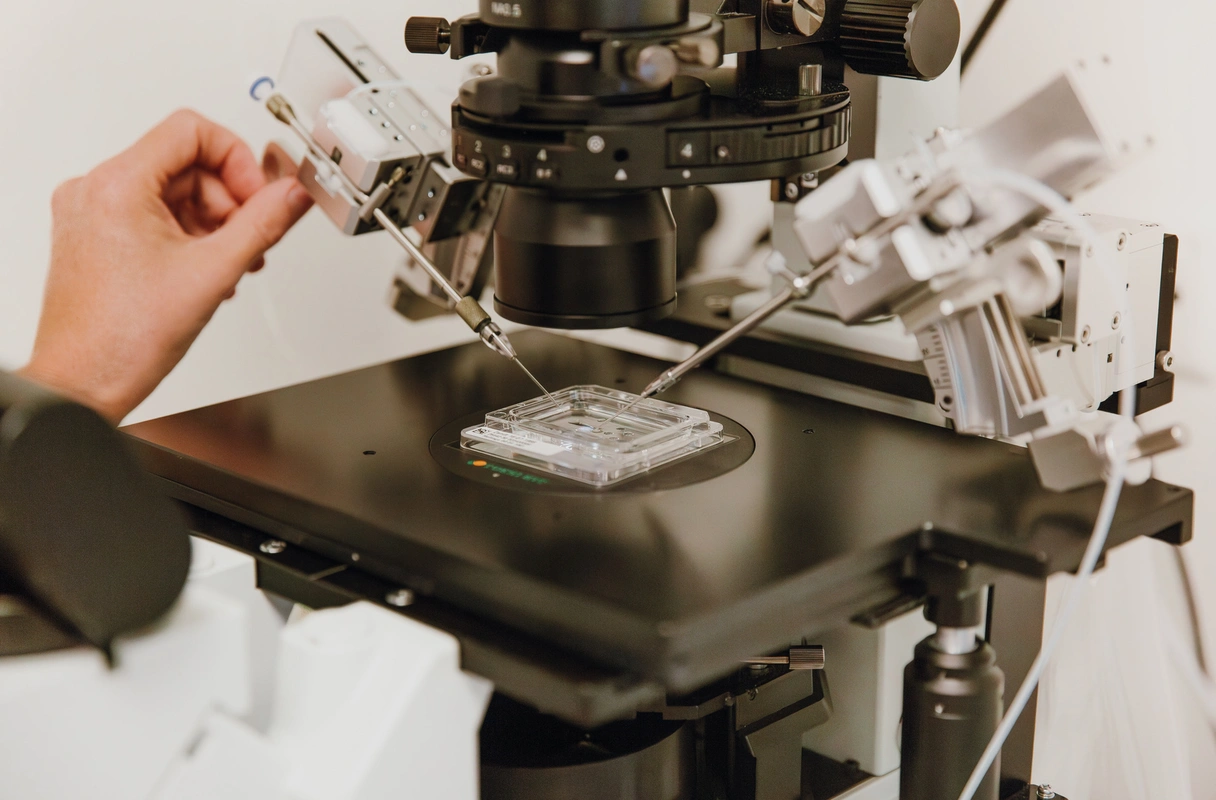
ICSI is a fertility treatment in which a single sperm cell is injected directly into an egg in the laboratory. If fertilisation is successful, an embryo develops. ICSI is often used in cases of reduced sperm quality or after several unsuccessful IVF attempts.
ICSI (intracytoplasmic sperm injection) is a form of IVF in which a single sperm cell is injected directly into an egg to promote fertilisation. After fertilisation, the embryo grows for a few days in an incubator. The embryo is then transferred to the uterus or frozen for later use. If the embryo implants successfully, you are pregnant.
This method is often used in cases of severely reduced sperm quality or if previous IVF attempts were unsuccessful.
For couples for whom other fertility treatments have not led to a pregnancy, or when no fertilisation of the eggs took place during an IVF attempt.
When severely reduced sperm quality is found in the male partner during the semen analysis and/or on the day of the egg retrieval. This reduced quality may be related to, among other things, a low sperm count, limited motility and/or abnormal sperm shape.

First, we carry out an initial fertility assessment (OFO). If the OFO shows that ICSI is the most suitable treatment, the doctor draws up a treatment plan. We discuss this treatment plan with you carefully and then turn it into a treatment schedule and timeline.
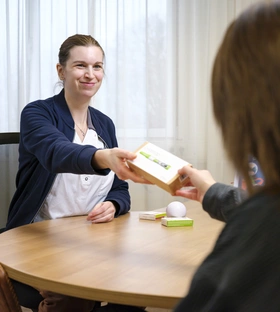
During the stimulation phase, the ovaries are stimulated daily with hormones so that multiple follicles grow. This phase lasts 10 to 14 days and is followed by trigger medication (hCG injection) to induce ovulation.
Using FSH medication
Every day you inject yourself with hormones in your abdomen, allowing multiple follicles to grow. How long you need to inject depends on the growth of the follicles. We monitor the growth of the follicles with regular ultrasound scans. When there are enough follicles and they are large enough, we schedule the egg retrieval.
Using hCG medication
Before the scheduled retrieval, you administer the trigger medication (hCG). This induces ovulation , loosening the eggs within the follicles so that they can be collected more easily during the retrieval.
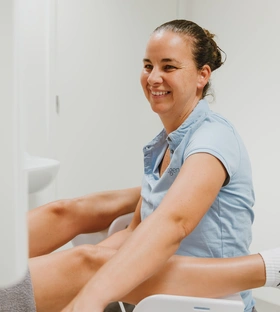
During the retrieval
During the egg retrieval, the eggs are aspirated from the follicles using a thin needle. You lie in the gynaecological chair and the doctor inserts a thin needle through the vagina to puncture the follicles and aspirate the eggs. These are then taken to the laboratory¹ for fertilisation.
After the retrieval
After the procedure, your recovery begins. We give you tailored advice to take home. You will hear the same day how many eggs have been retrieved. Then, as agreed with us, you start using progesterone to prepare the uterus optimally for the embryo transfer. After the procedure, you rest in our recovery room and we let you know how many eggs have been retrieved.
Pain relief
If you wish, you can use pain relief before the egg retrieval. Always discuss this with the doctor.
More information about what happens during an egg retrieval.
¹Nij Clinics Gorinchem does not have its own laboratory and therefore works together with Erasmus MC for heterosexual couples, and with the other Nij Clinics clinics for single women and lesbian couples.
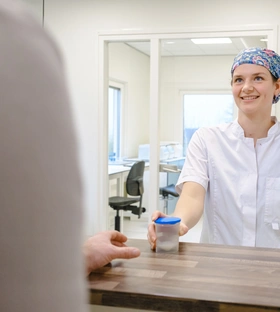
On the day of the egg retrieval, the sperm is prepared; how this is done depends on the situation:
¹Nij Clinics Gorinchem does not have its own laboratory and therefore works together with Erasmus MC for heterosexual couples, and with the other Nij Clinics clinics for single women and lesbian couples.
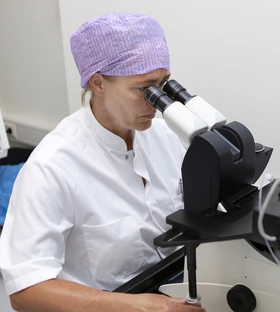
In the laboratory¹, the IVF lab technician fertilises the eggs with sperm cells from the intended father or sperm donor. A single sperm cell is injected into each egg. After fertilisation, the embryo grows for a few days in an incubator. The embryo is then transferred to the uterus or frozen for later use. If the embryo implants successfully, you are pregnant.
This method is often used in cases of severely reduced sperm quality or if previous IVF attempts were unsuccessful.
Fertilisation rates
It is important to know that not all eggs obtained during the retrieval will be successfully fertilised. Even if the sperm cell manages to penetrate the egg, this does not always result in successful fertilisation. Usually around 60–70% of the eggs are fertilised. These fertilised eggs can then develop further into embryos. On average, about half of these fertilised eggs grow into a good-quality embryo, but this can vary considerably from person to person.
¹Nij Clinics Gorinchem does not have its own laboratory and therefore works together with Erasmus MC for heterosexual couples, and with the other Nij Clinics clinics for single women and lesbian couples.
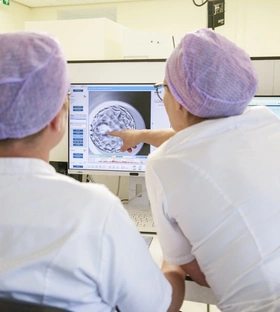
After one day, our embryologists can see whether fertilisation has taken place and whether an embryo has developed. The embryos are cultured in incubators in Petri dishes with a special culture medium. In the EmbryoScope , the temperature, humidity, CO2 and pH are regulated to create the ideal environment for culturing embryos.
EmbryoScope
With this EmbryoScope , our embryologists can use time-lapse technology to monitor the development of the embryos without opening the incubator and disturbing the embryos' environment. A photo of the embryos is taken every 10 minutes. The embryologists use advanced software to review the time-lapse recordings and select the best embryos for transfer and/or freezing.
We allow the embryos to grow for 3 to 5 days under optimised conditions. When the embryos have grown sufficiently and are ready for transfer, we schedule an appointment for the embryo transfer. The embryo with the best assessment is transferred. Any remaining embryos are frozen for a future transfer in a natural cycle.
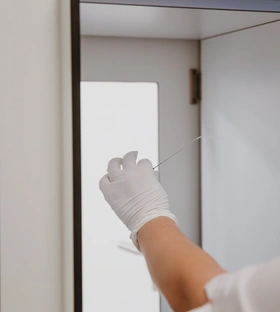
During the embryo transfer (ET), one embryo is transferred to the uterus to keep the risks as low as possible. In exceptional cases, for women over 38 or after three IVF cycles, two embryos may be transferred, although a multiple pregnancy carries greater medical risks, such as premature birth or pregnancy complications.
After the transfer
After the transfer, the embryo will implant in the wall of the uterus. To prepare the uterus for this, you started using Utrogestan after the retrieval. With a thicker endometrium with a better blood supply, the uterus is optimally prepared for the implantation of the embryo. In principle, you will not feel the implantation; 20 to 30% of women experience implantation bleeding.
You can take a pregnancy test eleven days after the embryo transfer.
Freezing embryos
Any remaining embryos are frozen for a future transfer in a natural or artificial cycle. You will discuss the policy for this with a doctor.

Ten days after the embryo transfer, you do a pregnancy test at home using morning urine. An exciting moment! Please let us know the result as soon as you have it.
Positive test – Pregnant
Congratulations! If the test is positive, we schedule an ultrasound scan at around 7 to 8 weeks of pregnancy. This is 3 to 4 weeks after the positive test. If the scan shows a well-growing embryo with a beating heart in the uterus, the treatment has been successful. We then refer you to a midwife of your choice for further pregnancy care. In some cases, a referral to a gynaecologist is needed. We would love to hear how your pregnancy and the birth go. Read more.
Negative test – Not pregnant
A negative test or the start of your period is of course disappointing. If your period starts, please contact us on the first day of your period to discuss the next step. If your period does not start and the test is negative, we would also like to hear from you, particularly in connection with stopping the medication. If you still have frozen embryos, you will discuss the policy for the next transfer with a doctor. If there are no embryos left, we can discuss the options for a new IVF treatment.
The success rates of ICSI vary depending on various factors, such as age and lifestyle, the cause of the infertility and the quality of the eggs and sperm.
²Not all clinical pregnancies lead to an ongoing pregnancy, as some end early in a miscarriage.
³The statistics shown are averages per transfer. No rights can be derived from them.
The costs of ICSI treatment consist of the appointments with specialists, the treatment, the medication and any storage costs for your own or donor material and/or embryos.
For an indication of the costs, please consult our list of fees .
If there is a medical indication, health insurers usually cover a number of treatments. Please check the conditions with your health insurer.
Please bear in mind possible additional costs (uninsured care):
The costs of the counselling session and the storage costs for donor material are listed on our list of fees.

No, you cannot choose between IVF and ICSI yourself. The doctor decides on ICSI based on medical indications. ICSI is recommended, for example, if the semen contains fewer than one million motile sperm cells, if antibodies are present in the semen, or if previous IVF treatments did not result in fertilisation.
Your doctor will discuss this indication with you and explain why IVF or ICSI is the best option in your situation.
Yes, you can prepare your body for pregnancy by following a healthy lifestyle. This means eating a varied diet, getting enough exercise, not smoking and not drinking alcohol or using drugs. A healthy weight also contributes to better fertility. We also recommend taking folic acid daily from the moment you want to become pregnant.
We can support you in leading a healthy lifestyle through lifestyle coaching and MijnFertiCoach. Do you have questions about your personal situation? Please discuss them with your fertility doctor.
16 days after the egg retrieval, you do a pregnancy test at home using morning urine. Exciting! Let us know the result as soon as you have it.
