
0 days
Average waiting time until intake
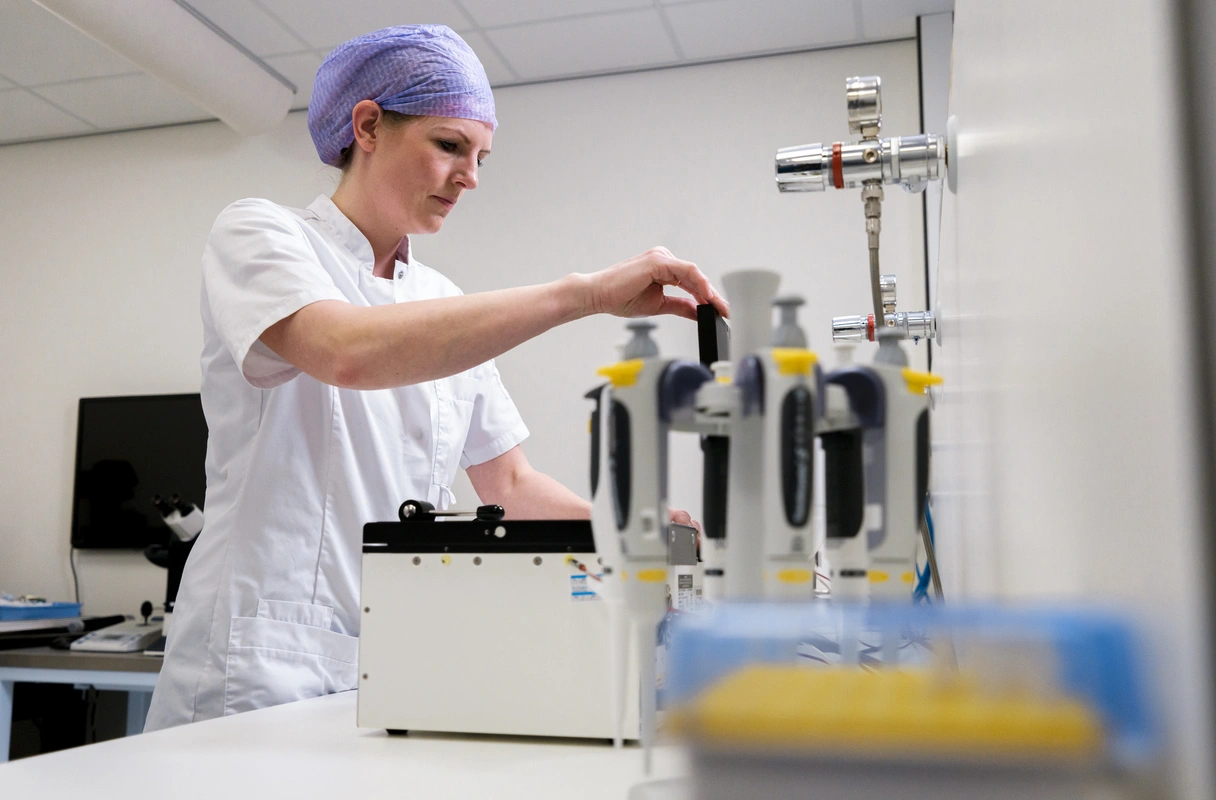
IVF ROPA (IRD), or IVF with shared motherhood, is a fertility treatment specifically for lesbian couples. One partner donates her eggs, the other carries the embryo. This way, both women are physically involved in the pregnancy.
IVF ROPA (Reception of Oocytes from Partner), or IVF with shared motherhood, is a fertility treatment specifically for lesbian couples. One partner provides the eggs (egg donation within the relationship), which are fertilised with donor sperm in the laboratory, after which the embryo is transferred to the womb of the other partner. This way, both women contribute physically to the pregnancy. For many lesbian couples, IVF ROPA is therefore a special way to share both a biological and an emotional connection with their child.
This treatment is also known as intra-relationship donation (IRD).
With ROPA, you share biological motherhood: one mother carries the baby, the other is genetically related through the egg. This strengthens your bond and, for many couples, makes parenthood even more shared and equal. ROPA gives you the opportunity to go through the whole process together, each making your own physical contribution. This strengthens not only your connection, but also your sense of shared responsibility and involvement.
Sometimes it makes more sense medically for one partner to provide the eggs (for example because of better egg quality) and for the other to carry the pregnancy (for example because of a healthy womb or better physical health). ROPA offers the flexibility to take this into account.
Whereas in standard IVF treatment one woman usually plays the main role, with ROPA you both go through an active part of the treatment. This makes the journey to parenthood even more something you share.
Many female couples tell us that ROPA helps them both feel like fully fledged mothers from the very first moment. This is of great emotional value, especially in the early stages of the pregnancy and after the birth.

Based on the results of the initial fertility assessment for both of you, you and your treating doctor will decide together whether IVF ROPA is a suitable treatment for you. During the intake and counselling sessions, we will discuss the options regarding donor sperm with you.
More information about: legal aspects and sperm banks
Important legal aspects of IVF ROPA
In the Netherlands, the woman who gives birth is automatically recognised as the legal mother. The genetic mother (the partner who provides the egg) can obtain legal parenthood without court proceedings if she is married to the birth mother, in a registered partnership with her, or living with her under a cohabitation agreement (samenlevingscontract). We will discuss this in more detail during our counselling sessions. More information is available on the website of Rijksoverheid.nl or on donorconceptie.nl
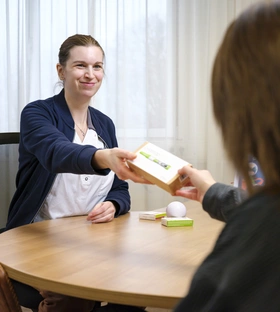
During the stimulation phase, the ovaries are stimulated daily with hormones so that several follicles grow. This phase lasts 10 to 14 days and is followed by trigger medication (an hCG injection) to trigger ovulation. Follicle growth is monitored by ultrasound.
Using FSH medication
Every day, you inject yourself in the abdomen with hormones that allow several follicles to grow. How long you need to inject depends on how the follicles grow. We check the growth of the follicles with regular ultrasound scans. When there are enough follicles and they are large enough, we schedule the egg retrieval.
Using hCG medication
Before the scheduled egg retrieval, the trigger medication (hCG) is given. This triggers ovulation, loosening the eggs within the follicles so that they can be collected more easily during the retrieval.
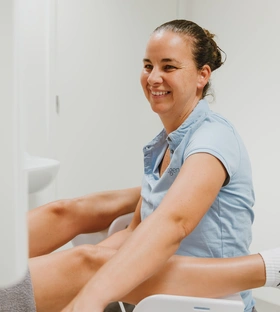
During the egg retrieval, the eggs are drawn out of the follicles with a thin needle.
During the retrieval, you lie in the gynaecological chair and the doctor inserts a thin needle through the vagina to puncture the follicles and collect the eggs. These are then taken to our laboratory for fertilisation.
After the egg retrieval
After the procedure, you rest in our recovery room and we will tell you how many eggs have been retrieved. Then, in consultation with us, the intended mother who will carry the pregnancy starts using progesterone to prepare the womb optimally for the embryo transfer.
Pain relief
If you wish, you can use pain relief before the egg retrieval; always discuss this with the doctor.
More information about what happens during an egg retrieval.
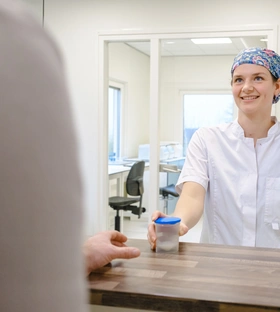
On the day of the egg retrieval, the sperm is prepared. How this is done depends on your situation:
More information about: legal aspects and sperm banks
¹The IVF ROPA method is only offered at Nij Clinics Elsendorp.
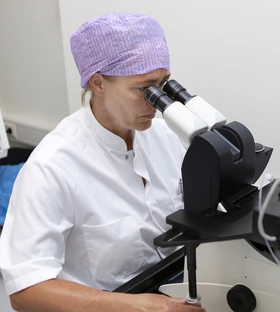
In the laboratory¹, the IVF lab technician fertilises the eggs with sperm cells from the intended father or sperm donor. Each egg is placed with 100,000 to 200,000 sperm cells. The strongest sperm cell has to penetrate the egg under its own power for natural fertilisation to take place.
Chances of fertilisation
It is important to know that not all eggs collected during the retrieval will be fertilised. Even if a sperm cell manages to penetrate the egg, this does not always lead to successful fertilisation. Usually around 70% of the eggs are fertilised; in the remaining 30%, the fertilisation process stops so early that it cannot be regarded as true fertilisation.
¹The IVF ROPA method is only offered at Nij Clinics Elsendorp.
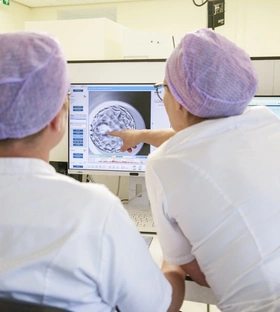
After one day, our embryologists can see whether fertilisation has taken place and whether an embryo has developed. The embryos are cultured in incubators in Petri dishes with a special culture medium. In the EmbryoScope , the temperature, humidity, CO2 and pH are regulated to create the ideal environment for culturing embryos.
EmbryoScope
With this EmbryoScope , our embryologists can use time-lapse technology to monitor the development of the embryos without opening the incubator and disturbing the embryos' environment. A photo of the embryos is taken every 10 minutes. The embryologists use advanced software to review the time-lapse recordings and select the best embryos for transfer and/or freezing.
We allow the embryos to grow for 3 to 5 days under optimised conditions. When the embryos have grown sufficiently and are ready for transfer, we schedule an appointment for the embryo transfer. The embryo with the best assessment is transferred. Any remaining embryos are frozen for a future transfer in a natural cycle.
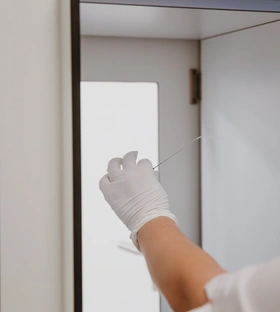
During embryo transfer (ET), one embryo is transferred to the womb of the partner who will carry the pregnancy, to keep the risks as low as possible. In women over 38 or after three IVF cycles, two embryos may be transferred in exceptional cases, although a multiple pregnancy carries more medical risks, such as premature birth or pregnancy complications.
After the embryo transfer
After the transfer, the embryo will implant in the lining of the womb. To prepare the womb for this, you started using Utrogestan after the egg retrieval. A thicker endometrium (lining of the uterus) is optimally prepared for the embryo to implant. Usually you will not feel anything of the implantation; 20 to 30% of women have some implantation bleeding.
You can take a pregnancy test fourteen days after the embryo transfer.
Freezing embryos
Any remaining embryos are frozen for a future transfer in a natural cycle.

About 14 days after the embryo transfer, you take a pregnancy test at home using your first morning urine. An exciting moment! Let us know the result as soon as you have it.
Positive test – Pregnant
Congratulations! If your test is positive, we will schedule an ultrasound scan at around 7 to 8 weeks of pregnancy. This can take place at our clinic or with your own midwife. If the scan shows a beating heart and the embryo is growing well, the treatment has been successful. We will then refer you to a midwife of your choice for the rest of your pregnancy care. In some cases, a referral to a gynaecologist is needed. We would love to hear how your pregnancy and the birth go. Read more.
Negative test – Not pregnant
A negative test, a scan showing no pregnancy or the start of your period is, of course, disappointing. You will discuss the next steps together with the doctor. When your period starts, please contact us on the first day of your period to start a new treatment. If you are not sure whether it really is your period, please check with us, especially regarding stopping your medication. If there are still frozen embryos, a next transfer can be planned in a natural cycle. If there are no embryos left, a new IVF cycle can be considered.
The success rates of IVF vary depending on various factors, such as age and lifestyle, the cause of the infertility and the quality of the eggs and sperm.
²Not all clinical pregnancies lead to an ongoing pregnancy, as some end early in a miscarriage.
³The statistics shown are averages per transfer. No rights can be derived from them.
The costs of IVF treatment consist of the appointments with specialists, the treatment, the medication and any storage costs for your own or donor material and/or embryos.
For an indication of the costs, please consult our list of fees .
With a medical indication, health insurers usually cover a number of treatments. However, this treatment is often carried out without a medical indication. Check with your health insurer what their conditions are.
Please bear in mind possible additional costs (uninsured care):
The costs of the counselling session and the storage costs for donor material are listed on our list of fees.

No, the woman who donates the egg is not automatically the legal mother. By law, only the woman who gives birth to the child is. The genetic mother must arrange legal parenthood separately through acknowledgement or adoption, depending on the situation.
With IVF using ROPA, only the birth mother is automatically a legal parent. Do you both want to become legal parents? Then the legal parenthood of the genetic mother (who donated the egg) must be arranged separately. How this is done depends on your situation:
Married or in a registered partnership:
Are you married or registered partners and are you using a sperm bank donor? Then the partner of the birth mother does not automatically become a legal mother as well. For this, a declaration must be submitted. In this case, however, the partner of the birth mother does immediately become a joint holder of parental authority.
Known sperm donor:
When using a known sperm donor, the birth mother decides who becomes the second legal parent: her partner or the donor. This must be properly arranged in advance. Always seek guidance from a specialised lawyer.
Not married and not registered partners:
If you are not married or not registered partners, legal parenthood can only be obtained through acknowledgement or adoption.
With ROPA in a Dutch clinic, the partner donating the egg is registered as a donor. The details are recorded with the Donor Data Board for Artificial Fertilisation (College donorgegevens kunstmatige bevruchting, CDKB), as required under the Artificial Fertilisation Donor Data Act (Wet donorgegevens kunstmatige bevruchting, Wdkb).
