On 1 April 2025, the Artificial Fertilisation Donor Data Act (Wet donorgegevens kunstmatige bevruchting) was amended. The Donor Data Board for Artificial Fertilisation (Stichting donorgegevens kunstmatige bevruchting, Sdkb) is now called the Donor Data Board for Artificial Fertilisation (College donorgegevens kunstmatige bevruchting, CDKB). The most important change is that the CDKB can now centrally monitor that the sperm of one donor is used for a maximum of 12 women. This helps prevent large networks of genetic relatives from forming. This was not possible before, as there was no legal basis for comparing the donor data registered by the clinics.
In recent months, a donor code has been linked to every unique donor already registered. All registered women have been given a mother code linked to the donor code of the donor whose gametes were used in their treatment. A maximum of 12 mother codes is available per donor. Thanks to this new way of registering, the CDKB and the clinics have gained more insight into the number of offspring per donor conceived through clinics in the past.
From 2004 to 2018, clinics followed the professional guideline of a maximum of 25 offspring per donor. In 2018, this guideline was changed to a maximum of 12 families per donor. To avoid confusion when determining whether this guideline on the maximum number of offspring per donor has been exceeded, the maximum of 25 offspring per donor has been taken as the starting point. After all, the aim both before and after 2018 was to limit the number of offspring per donor.
Of these 85 donors:
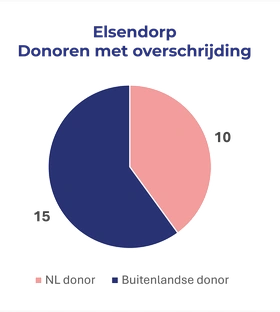
The national registration shows that the guideline was exceeded* for 25 donors. This includes 2 donors from our own bank.
Dutch donors exceeding the guideline
The Dutch donors were all active at several Dutch clinics, including Nij Geertgen (and/or Stichting Geertgen). At Nij Geertgen, this resulted in 168 registered pregnancies.
Foreign donors exceeding the guideline
The other 15 foreign donors were also active at 2–7 Dutch clinics, including Nij Geertgen (and/or Stichting Geertgen). At Nij Geertgen, this resulted in 182 registered pregnancies.
*The guideline is exceeded when there are more than 25 registered ongoing pregnancies.
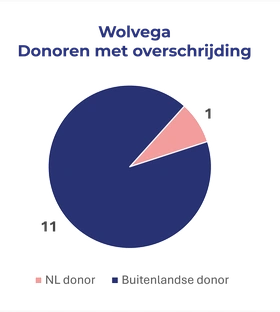
The national registration shows that the guideline was exceeded* for 12 donors. None of these donors are from our own bank.
Dutch donors exceeding the guideline
The Dutch donor was active at a total of 3 clinics, including Nij Barrahûs. At Nij Barrahûs, this resulted in one registered pregnancy.
Foreign donors exceeding the guideline
The other 11 foreign donors were also active at 3–7 Dutch clinics, including Nij Barrahûs. At Nij Barrahûs, this resulted in 42 registered pregnancies.
*The guideline is exceeded when there are more than 25 registered ongoing pregnancies.
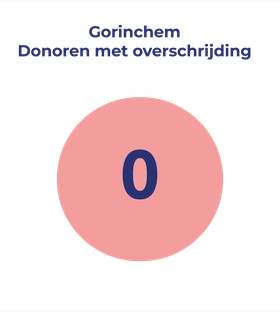
At Nij Linge, the guideline has not been exceeded*.
*The guideline is exceeded when there are more than 25 registered ongoing pregnancies.
If you would like more information as a parent or donor, please contact us. We aim to get back to you within one month at the latest.
You will receive an e-mail from us with specific information about your situation. If you would prefer to hear this information in person, you can indicate this in the form below.
Requesting information
How you can request more information depends on your personal situation:
Additional information
Please bear in mind that these numbers are based on the data currently registered with the CDKB. Treatments may still take place with a donor's sperm if the maximum of 12 women per donor has not yet been reached. For treatments before 2004, on the other hand, it is not certain whether all treatments were registered with the CDKB, because the Artificial Fertilisation Donor Data Act did not yet exist at that time.
There are several reasons why the limit has been exceeded:
News about a large number of half-siblings can have an impact on families and donors. The website of Fiom, a centre of expertise on questions of kinship and origins, offers guidance on how to deal with this. You can also contact Fiom for short-term support.
Information on this subject can also be found on the websites of the National Donor Conception Information Point (Landelijk informatiepunt donorconceptie, LIDC) and the CDKB.
Do you have questions, or would you like more information about donating or ordering donor material? Feel free to contact our donor bank.
Our specialised team is ready to help and support you at every step of the process.