during fertility treatment
Ovarian hyperstimulation syndrome (OHSS) is a possible complication of fertility treatments such as IVF and ICSI. In these treatments, hormones are given to stimulate the ovaries and allow multiple eggs to mature. Sometimes the ovaries respond too strongly to these hormones, which leads to a condition known as ovarian hyperstimulation syndrome (OHSS), or overstimulation.
Overstimulation occurs when the ovaries overreact to the hormone treatment, resulting in too many follicles. This can lead to a swollen abdomen, fluid retention and, in some cases, serious complications. The excessive production of follicles can also increase the risk of cysts or bleeding in the ovaries. This occurs in around 2 per cent of IVF/ICSI treatments. The risk is higher in young women and in women whose follicle maturation is disrupted (PCO syndrome).
To prevent overstimulation, regular ultrasound scans and blood tests are carried out during the stimulation phase. Even so, your body may react strongly to the hormone stimulation. If the scan shows many small follicles and the oestrogen level in your blood is very high, the doctor may decide to stop the treatment early. After a recovery period of 2 to 3 months, a new attempt can be started.
Sometimes it only becomes clear after the trigger injection (hCG) that overstimulation has occurred. In that case, the eggs are still retrieved, but no embryo transfer takes place. The embryos are then frozen for a later cycle. This avoids risks, as a pregnancy can make the symptoms worse.
It is therefore important not to have unprotected sex during this period. Use a condom to prevent pregnancy and complications.
Look out for symptoms such as rapid weight gain (>1.5 kg per day), a swollen abdomen, pain, nausea or shortness of breath, and contact us immediately if you are in any doubt.
The symptoms of overstimulation can range from mild to severe. In most cases, women experience mild to moderate symptoms such as:
In some cases, the symptoms can be more severe and require medical attention, so do not hesitate to contact us.
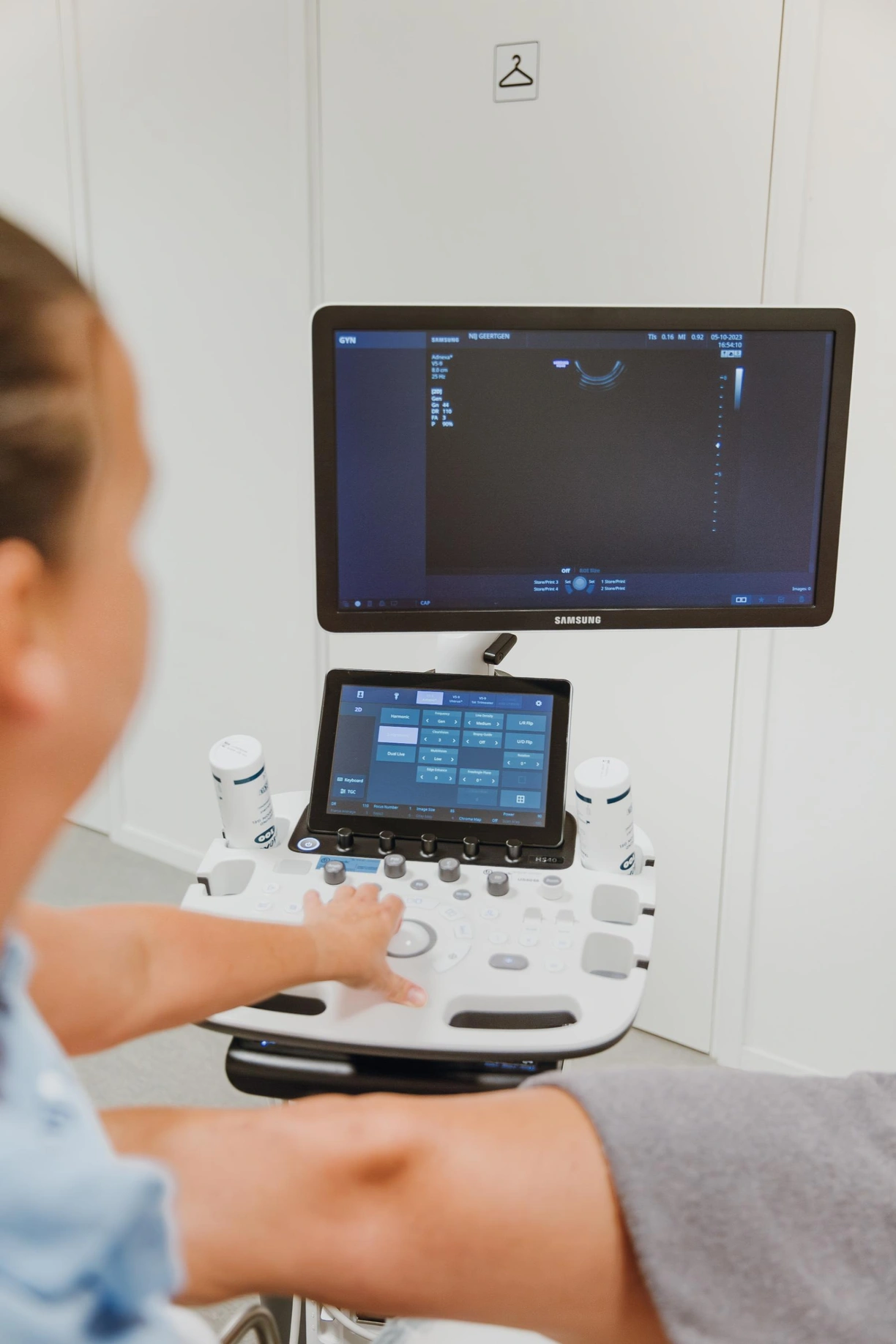
During fertility treatment, your ovaries are stimulated to grow multiple follicles. It is important that this happens in a controlled way to prevent overstimulation (OHSS). That is why we regularly carry out internal ultrasound scans during this phase to closely monitor the number of follicles and the hormone levels in your blood.
Even so, too many follicles may sometimes develop and your oestrogen level may become too high. In that case, the doctor may decide to pause the treatment so that your body can recover. After around two to three months, a new attempt can then be made.
Around the time of the egg retrieval, we advise you not to have unprotected sex. If overstimulation does occur, it is important to prevent a pregnancy. So please use a condom.
The doctor may not expect overstimulation, and impending overstimulation may only become apparent after the hCG injection (the trigger injection) has been given. A pregnancy could then have serious consequences.
The follicles are still retrieved from the body during the egg retrieval and the laboratory phase of the IVF or ICSI treatment can go ahead as normal. However, we will decide not to carry out an embryo transfer in that cycle and to freeze the embryos (with your consent).
After thawing and further cell division, these embryos can later be used for transfer in a natural (non-stimulated) cycle. We advise you not to have unprotected sex during this period. A pregnancy must be avoided if OHSS is threatening, so please use a condom.