
Personal
With personal support, we make sure everyone feels heard and at ease.

With a fertility assessment, we try to find out why you are not getting pregnant, so that we can then decide on a treatment plan.
If you have not become pregnant despite having regular unprotected sex for a year, you can have a fertility assessment. This assessment identifies whether there are medical reasons that explain why you are not getting pregnant.
In both the man and the woman, we look at various aspects of fertility, such as egg quality, ovulation, whether the fallopian tubes are open and sperm quality. Sometimes no clear cause is found, but in other cases targeted treatment can increase the chance of pregnancy. A fertility assessment is therefore often the first step towards clarity and, where needed, support in getting pregnant.

Before your first visit, you and your partner (if applicable) will receive a detailed questionnaire¹, so that the doctor can prepare for the consultation. Your answers are included in your medical history.
Together with you and your partner (if applicable), the doctor discusses questions about your general health, lifestyle, psychological and emotional health, medical history, sex life, use of medication and hereditary factors (such as possible fertility problems in the family).
Women: Women are also asked about their menstrual cycle, any previous gynaecological problems, sexually transmitted infections (STIs) and any abdominal surgery. Any previous pregnancies, births and how long you have been trying to have a child are also discussed. Any difficulties with intercourse can be shared in confidence with your healthcare provider.
Men: The male partner (if applicable) is asked additional questions about, for example, previous (groin) surgery, descent of the testicles, epididymitis, varicocele, STIs and the results of any previous semen analysis.
¹At Nij Clinics, we work with questionnaires (medical history forms). We ask you to complete a questionnaire digitally and send it to us some time before the intake. By the time of your first visit (intake), the doctor will have studied this information, and it serves as input for the consultation. How you send it may differ per clinic. After registering, you will be told how to send it to us.

Blood tests can help to establish why you are not getting pregnant. Based on your medical history, the doctor can indicate whether blood tests are needed and which values should be measured. Blood can be taken at our clinic, often after the consultation (by a nurse), or on a specific day in your cycle as instructed by the doctor.
If you have had blood tests elsewhere, for example via your GP or a previous healthcare provider, we would also like to receive those results. One or more of the following tests are most commonly carried out after the intake: CAT, TSH, AMH, FSH, LH, oestrogen, progesterone, prolactin.
Results
We discuss the results of the blood tests with you during the second consultation. Together with the results of the other investigations, this gives a complete picture, after which we decide whether fertility treatment is appropriate and which treatment suits you best. Sometimes the blood tests show that further investigations are needed. You may need another blood test, a foam ultrasound , or a referral to another specialist.

During the fertility assessment, you will have a transvaginal ultrasound (internal scan). This allows the doctor to examine your uterus and ovaries. For this scan during the intake, it does not matter which day of your cycle you are on. It is also fine if you are having your period. The scan is not painful and uses safe, high-frequency sound waves to create images.
The doctor gently inserts a slim ultrasound probe into the vagina. The examination is most comfortable with an empty bladder. The doctor looks at your endometrium (lining of the uterus) and the visible follicle count (AFC) in your ovaries. The doctor also checks for any abnormalities, such as a cyst, fibroid or polyp. This overall picture helps to assess your fertility.
If the results show an abnormality, the doctor may first refer you to a gynaecologist elsewhere for further investigation before recommending fertility treatment. Or sometimes your medical history shows that additional imaging is needed to check whether your fallopian tubes are open. In that case, our own doctors can carry out a foam ultrasound .

We arrange cycle monitoring if you have an irregular cycle. During the medical history consultation we get a good picture of your fertility, but sometimes it is unclear why your cycle is irregular. Monitoring your menstrual cycle allows us to look at several aspects of your cycle, such as menstruation, the follicular phase, ovulation and the luteal phase.
During monitoring, we use ultrasound scans to see whether a dominant follicle is growing. If so, we check whether ovulation follows. Several scans within one cycle are usually needed. If no dominant follicle has been seen after three weeks, we stop the monitoring. Based on the outcome of the monitoring and your other test results, the doctor can discuss with you which fertility treatment best suits your situation.
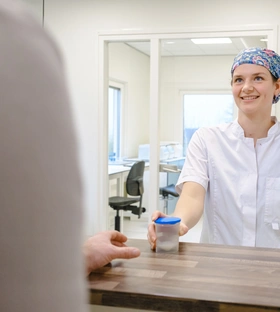
If you have a male partner, we will also carry out tests on him.
In men, sperm quality is important for the chance of pregnancy. This can be assessed with a semen analysis. We make an appointment for this at the laboratory. The sperm sample can be produced at home or at the clinic by masturbation, collecting the sperm in a special sample pot.
If you collect the sample at home, it is best for the result if the sperm stays at body temperature (for example, keep the pot under your clothing against your skin). The pot must be handed in at the laboratory within one hour, otherwise it may affect the result. In the semen analysis, we examine the presence, number and motility of the sperm cells.
If (serious) abnormalities are found, you may need a referral for further tests. These further tests are carried out by a urologist specialising in andrology.
The following tests may then be carried out:

During the treatment planning consultation, the doctor will discuss the test results with you and explain the possible treatment options.
Additional tests
If necessary, additional tests may be carried out, such as a test to check whether the fallopian tubes are open (foam ultrasound) or a repeat blood test or semen analysis. You may also be referred to another specialist before we can start fertility treatment.
The fertility assessment may take longer than you and your partner expect: each step simply takes time. If you have any questions, you can discuss them with the gynaecologist or fertility doctor. If the tests feel too demanding, talk to the gynaecologist or fertility doctor about how they can be carried out step by step, at your own pace.
Yes, we offer emotional support during your treatment. You can make an appointment yourself with one of our psychologists or the medical social worker. Nij Clinics | Elsendorp also has nurses from the Extra Support team (Extra Steun) available to support you.
We are here to support you throughout your fertility journey. Please do not hesitate to contact us if you would like to make use of this.
It is not possible to single out one fertility treatment as the most successful. Success depends on factors such as the woman's age, sperm quality, medical history and other personal circumstances. Together with your treating doctor, we look at the treatment that offers the best chance of pregnancy in your situation.
