
Blogs
23-09-2026
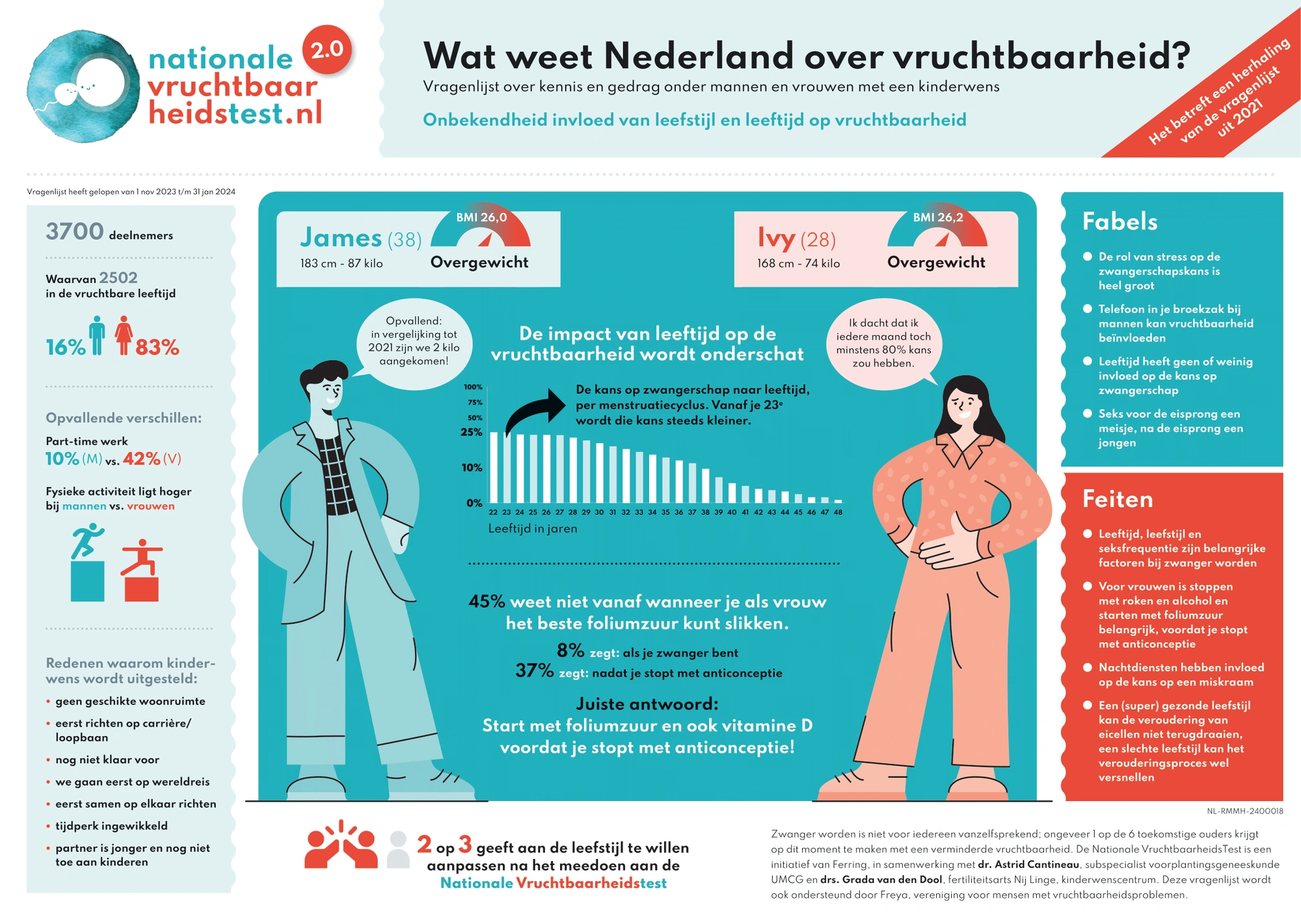
Fertility doctor Grada van Dool notices that more and more couples and women aged 35+ are coming to her consulting room. And these couples often do not realise that fertility depends on age. “From the age of 35, a woman's fertility declines, and for men from the age of 45,” Grada explains. “My fellow doctors and I wondered why there is this lack of awareness. We felt that there needs to be more education.”
Why is it that more and more so-called intended parents are postponing their wish to have a child?
Grada: “Often because there is no suitable housing, their career takes priority or they still want to travel the world. The thinking seems to be that there is always time for a child. But eventually, your age really does start to play a part. People often think: there is always IVF, which will solve this for me, but unfortunately that is not the case in practice.”
So when, according to the fertility doctor, is a good time to start a family?
“A well-known Dutch saying is, of course, a smart girl starts on time, but there is also a social idea behind it. When we see a 21-year-old patient, we often think: oh dear, how young. But on the other hand, she is starting on time. Just as teachers are surprised when a student becomes pregnant at 22 before finishing her studies. These days it is also difficult for women to really start on time. So it is quite logical that women are postponing their wish to have a child nowadays.
I also fully understand that you first want to have your finances in order and, for example, find suitable housing. And after a simple calculation, you are quickly past 35, so in that respect these are logical developments. But unfortunately not good for your fertility. I often enough see women over 40 in tears in the waiting room, who had not realised they could be too late. And someone aged 40 or 42 can still have a wonderful child, of course, but the chances are simply somewhat lower. And that is the awareness I would like to create.”
What strikes the fertility doctor is that people often greatly overestimate their fertility, while 1 in 6 intended parents face reduced fertility. Previously this figure was 1 in 10, so it has increased over recent decades. Stress is often cited as a cause, but according to Grada it has only a limited influence. “There is stress-stress and there is stress. Look, a little stress and adrenaline through your body now and then is actually good for you. But being continuously exposed to negative stress is unhealthy. Anything that gnaws at your health also gnaws at your eggs. So stress does affect you, but not as much as most people think.”
What has been proven to have a negative effect is an unhealthy lifestyle. “Smoking, alcohol and drug use are harmful to fertility, but that is common knowledge. What many people do not know is that these harmful effects do not disappear immediately when you stop. If you are born a girl, you already carry the eggs you will have for the rest of your life.
So my tip is: live as healthily as possible. Even with very good health, you probably cannot make your eggs or sperm cells better, but we do know that an unhealthy lifestyle – such as smoking – can halve your chances of pregnancy.”
Grada also emphasises that a combination of diet and exercise is important for your health. Yet the National Fertility Test (Nationale Vruchtbaarheidstest) shows that the average respondent is 2 kilos heavier than in the previous survey in 2021.
“A one-sided diet with too little exercise is disastrous; in fact, we all move too little. The advice is to do something every day for thirty minutes that raises your heart rate. That can simply be half an hour of brisk walking, cleaning the windows or half an hour of sex. That raises your heart rate too.”
The infographic shows the results of the National Fertility Test. This questionnaire was completed by 3,700 participants between November 2023 and February 2024.